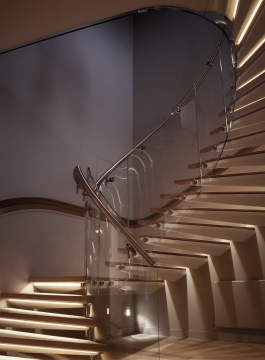

GRAS were approached to reconfigure and amalgamate two A-listed properties into one at Royal Terrace in Edinburgh. The brief was to create a two story dwelling with 3 public rooms, 4 bedrooms and a large dining/kitchen linked by a new stair. As it was the most significant alteration to the property and pivotal to the success of the project the client was keen to explore the possibility the clients were keen to explore the possibilities of the stair. Positioned at the heart of the house the stair linking the two levels together allows as much light as possible into the lower ground floor level.
Inspired by the work of sculptors Locky Morris and Barbara Hepworth, the proposal endeavoured to abstract the floor surface to form a sculptural, flowing spiral. The conventional spiral stair plan has been twisted so that the leading edge of each tread runs perpendicular to the tangent of the central void, meaning that visually, each tread tapers into the next creating a continuous timber surface when viewed from above. In order to achieve this complex geometry while allowing light to pass through the structure, each tread is supported on a unique cantilevered steel profile tapering in plan and section. While forming a single solid surface when viewed from above, the profile of the treads mean that each step is viewed as an individual element from below: visually reminiscent of turbine blades or a wing profile. The light flows between the steps and creates different qualities of light and form when viewed from any point in the space. A central glazed balustrade is supported from the end of each cantilevered tread, while a recessed handrail runs around the perimeter wall.
- Project Details
- Project Team
Location
Edinburgh, Scotland
Completed
2008
Type
Interior