
The aim of this project was to interrogate the notion of a building as a product rather than a process. By allowing visitors the chance to see Hill House as they have never seen it before, the Hill House Visitor Centre would have demanded an alternative perspective on the nature of permanence, the role of conservation and the future of Hill House. In collaboration with Invisible College / NVA, our proposal was to invite the public to engage in the story of a building as it emerges through its period of construction, use, and ultimate disassembly. Set alongside the planned conservation works on Hill House, this would have proven an engaging, thought-provoking and progressive critique on the future of Mackintosh’s buildings, and indeed all existing buildings.
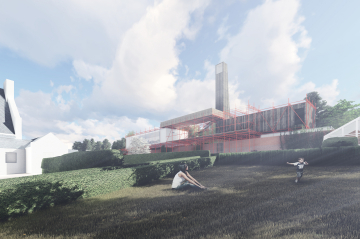
Positioned along the back wall of the garden, the Hill House Visitor Centre provides a visible and accessible gateway to the grounds from both the traditional gated entrance and the carpark to the rear. From atop the garden wall, the visitor would experience a side of Hill House not usually acknowledged, while also enjoying a view of the River Clyde beyond the rooftops of Helensburgh. In contrast to the sculptural mass of Hill House, the Visitor Centre comprised a skeletal structure of scaffolding that sits lightly on the ground, stepping over the wall and bridging the carpark and garden; woodland and house.
Low cost, readily available and easy to assemble: traditionally, scaffolding is the parasite that clings to a building, In this instance, however, the scaffolding itself is the host, with the voids between the poles providing the spaces into which building boxes are nested. A definitively temporary architecture, this building is modular, demountable and adaptable. Its fragmented form allows the existing trees to remain standing in the voids of the structure, and encourages new growth to interact with the building over the temporary period of its existence.
- Project Details
- Project Team
Location
Helensburgh, Scotland
Completed
2017
Type
Cultural

